One platform under all three tools
Identity, access, audit and links are built once and shared, so Minerva, Caelus and Mercury behave the same way.
How the pieces fit
Three tools, one platform underneath them.
- One sign-inOne account for all three tools: a Castra account, or your own provider.
- Shared permissionsDirectory groups map to roles, once, for all three tools.
- One audit logTamper-evident, covering Minerva, Caelus and Mercury.
- Links and embedsSmart links and live previews, shown only to people allowed to see them.
- Minerva, Caelus and Mercury all sign people in through one OIDC sign-in, use the same directory groups and permissions, and write to one audit log.
- A Caelus page can embed live Minerva issues and Mercury tickets.
- Minerva issues and Mercury tickets can link to each other.
- Your identity provider, where you use one, supplies sign-in (OIDC) and users and groups (SCIM).
Identity
Sign in through any OIDC provider, such as Microsoft Entra ID, Okta, Google Workspace, Auth0 or Keycloak.
- Users are keyed on a persistent identity, not an email address, so a changed email does not create a new person
- Your identity provider is the source of truth for who people are and which groups they belong to
- People and groups stay in step with your directory through SCIM 2.0, Keycloak, or any directory or HR system with a JSON API
- Colleagues can be found and picked before they have ever signed in
- Leavers lose access at once, with their history kept
- Account recovery stays with the identity provider; Castra never handles passwords
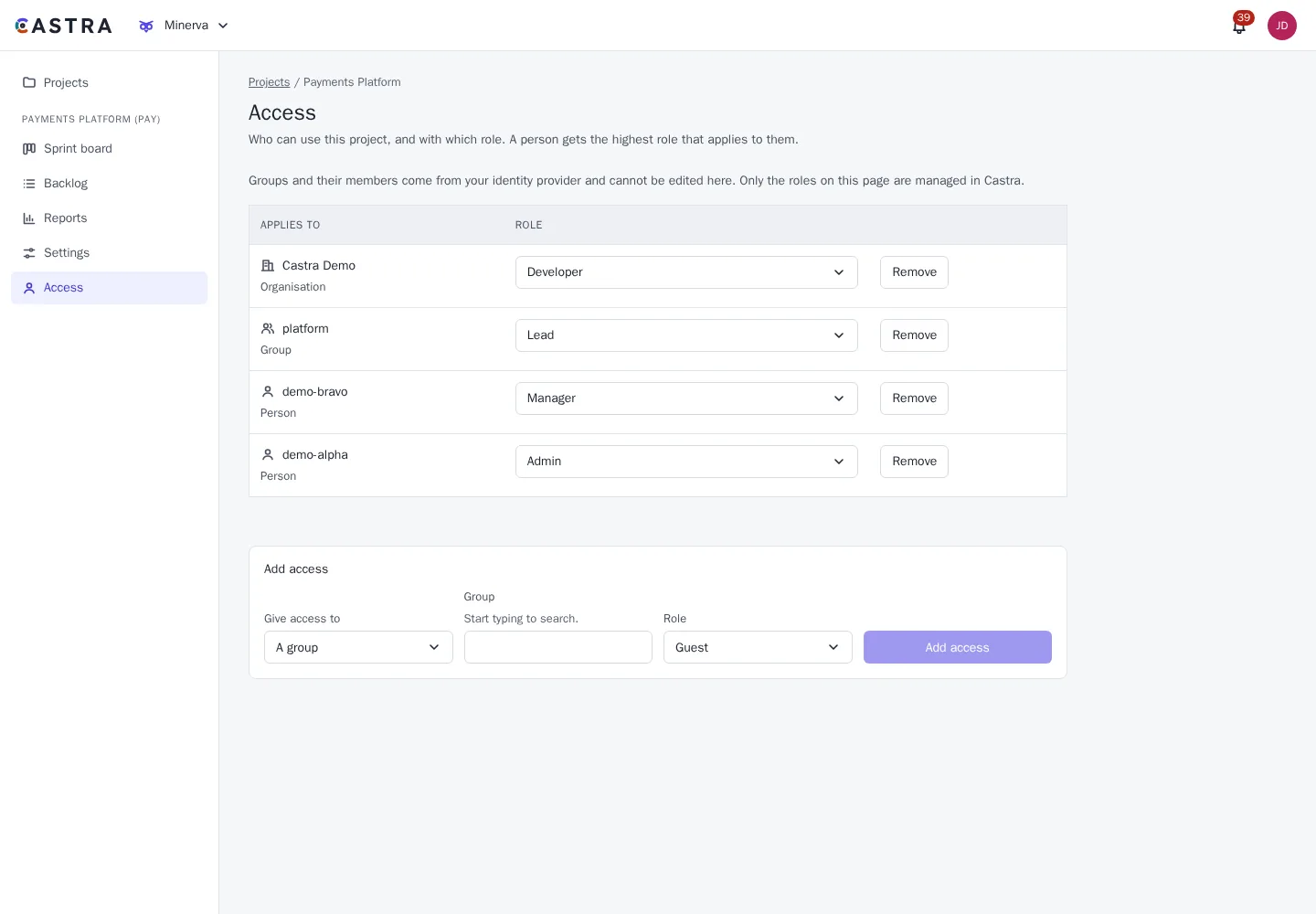
Access, in three levels
Access is set at the level that fits, from the whole installation down to one project.
- PlatformThe installation as a whole.
- OrganisationA tenant of the platform, such as a company or department.
- ProjectWhere the day-to-day work happens.
Project admins map directory groups to roles. A grant can go to the whole organisation, to a directory group, or to one person. Because the identity provider is the source of truth, removing someone from a group removes the access that came with it.
Audit log
Activity across all three tools is written to one tamper-evident log, including exceptions such as a guessed ticket reference. Stream it to OpenTelemetry, HTTPS or syslog.
Smart links
Paste a link to an issue, page or ticket in any tool and it turns into a live preview, subject to what the reader is allowed to see.
Federation
Organisations stay separate by default. Controlled cross-organisation federation lets two of them share what they choose to.
API, tokens and webhooks
One API for all three tools, with scoped tokens that expire. Signed webhooks tell your other systems when something changes, with retries and a delivery log.
Phone and desktop
Install Castra on a phone or computer from the browser. Recent items, tickets and pages stay readable offline, and push notifications carry only the event and a link.
Clear notification emails with an action button, sent to the people admins choose. An optional morning briefing sums up your day at a time you pick, and skips days with nothing to say.
Works with your other tools
Development
Branches, commits, pull requests, builds and deployments on each item, from GitHub, GitLab, Forgejo, Bitbucket and any CI. Rules can run when a pull request merges.
Chat
Notifications to Slack, Microsoft Teams, Mattermost, Rocket.Chat, Matrix, Zulip and Discord-compatible channels. Slash commands and link previews in Slack, Mattermost and Rocket.Chat. Channels can show the start of comments if you choose. Internal content never goes to chat.
Moving in
Import from other agile, service desk and wiki tools, keeping issue keys, and from GitHub, GitLab, Redmine and Trello. Import credentials are never stored.
Incoming webhooks
Other systems can call Castra to run a rule, or to create an item or a ticket. Signed calls carry a timestamp, so they cannot be replayed.
Export and restore
Export a whole organisation as one archive, files included and the audit chain kept, and restore it. Backup scripts cover the whole install.
Retention and monitoring
Retention policies clear out old data, with a dry run first and legal holds. A metrics endpoint feeds your monitoring.